Why We Struggle to Accept Aging & Imperfection
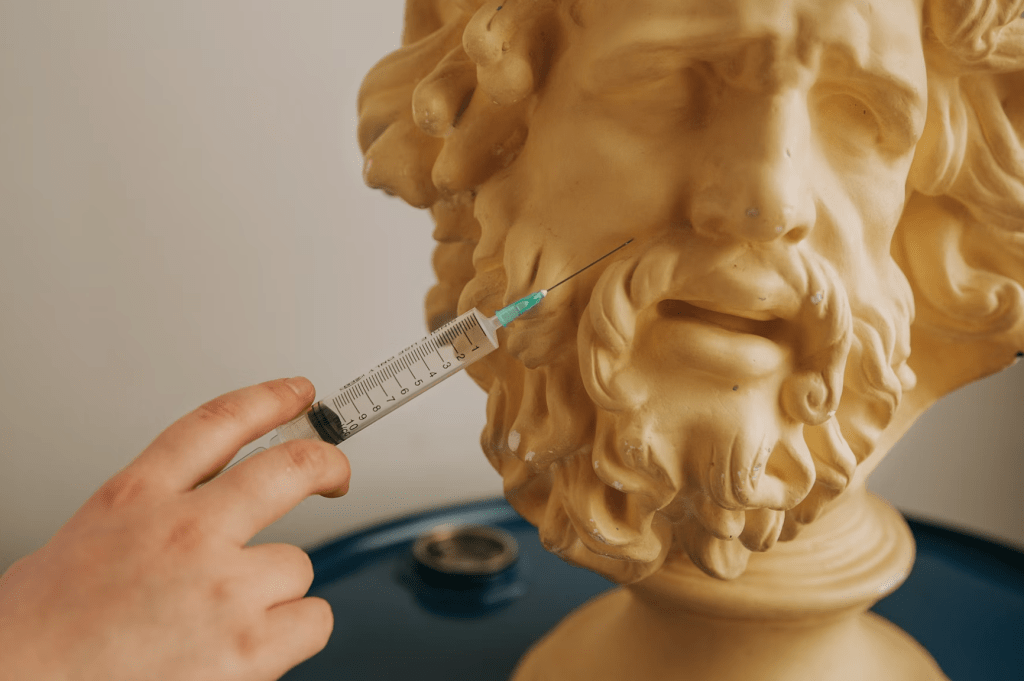
I haven’t gotten botox.
There are lots of reasons for this.
I’m still pretty young; I discovered good skincare early; I’m afraid of needles and injecting toxins into my face by instinct; and I discovered Frownies a little while back and am reasonably committed to using them, depending on the season.
Since working in entertainment and learning just how prevalent various procedures really are, I’ve thought about it all a lot, and have thought often how, while it’s hard to promise, my sincere desire is to let myself age—as a statement of what really matters, as a bit of realism and humility in the face of our inescapable finitude, and as a pointing to my belief in God and the fact that maybe what happens fairly naturally is what is supposed to happen.
Maybe it’s just good for us to allow the brightness of youth to fade.
Maybe it’s just good for us to accept an imperfect nose or a softening jawline.
Maybe imperfection and wrinkles and less-than-runway features help us gently grow into maturity, valuing the deeper parts of ourselves and others over evasive, conventionally-perfect aesthetics.
And maybe, too, although we may not be able to fully see it here, we are even most beautiful physically as we really are. In the way candy will always be preferable to a child’s undeveloped palate, a certain narrow aesthetic will only ever be desirable to some. But as connoisseurs of reality, developing a true spiritual and artistic palate, maybe the real thing really is more exquisite, like caviar and good wine.
But the reality remains: the temptation is there, for me and for everyone, especially as the facelifts become imperceptible except for the fact that they look too shockingly good. The pressure to look 30 at 70 becomes bizarrely real now, and aligned with growing trans-humanist fantasies: who wants to grow to be 200 if we have to look like we are that old?
No one wants to be sage; everyone wants to be hot forever.
Truth be told, I have sympathy and little judgment for those who do proceed with plastic surgery, fillers, botox, and whatever else happens to be on the current looks-improvement menu, especially for professionals in entertainment. I have this empathy because I’ve had to dial in quite directly to the experience of those in the limelight in my time working as a singer and writer and shuffling around in that devastatingly critical milieu.
It is one thing to have a wistful moment in the mirror seeing something not quite perfect and then moving on to our day; it is an entirely different thing having a world full of people callously discussing those imperfect features, or the few extra pounds, or the signs of a full life decades down from early youth.
I’ve had to contemplate what it really means to be grotesquely evaluated based purely on looks, from every angle, and lightyears away from the generous eyes of authentic love. In a time of online projection, everyone now seems subject to this same pressure increasingly more as well, a pressure that only used to apply to the professionally beautiful. Modern life is overwhelming.
What good is it to exist, if it can’t be proudly displayed? What good is it to exist, if my face can’t be perfect online?
The desire for perfection, even physical perfection, however, is not just a primitive survival response or an artifact of social pressure.
It is, I would argue, only misplaced in time.
The Modern Search for Beauty and Perfection
This rest of this article is for those who believe in an eternal timeline for human life, and the actual, physical resurrection of the body in the afterlife. So, if that’s your thing, or it interests you, stay with me for a bit more here.
What started this thought process for me was discovering facial massage the last few years, and then watching my various feeds fill up with all kinds of fascia release work, palate expansion, supplements, face exercise techniques, and lymph drainage strategies: enough to fill up one’s whole life with.
I found myself thinking of the head-shaking the earlier generations would give at our preoccupation with physical perfection–those who woke up at 5am to milk cows and raise twelve children and laugh their way through sleepless nights to the grave with a Rosary in their hands, joyfully spent from a life of sacrifice and love.
But I also felt the staggering fascination inherent in these strategies: that the face could in fact be largely preserved not just through the force of surgery, but in recognizing beauty’s connection to health and bodily order, and that the limits of that have not even begun to be upon us if what I’m seeing is accurate. In theory, with enough commitment, one really could look impressively good many decades past when the culture says we will “expire.”
In my small way, I’ve seen the results, and I’m not alone.
Some of the people showcasing these techniques have completely changed their faces, looking younger and more modelesque now than themselves 15 years ago or more. And it reveals an important principle: dramatic beauty is available to most people, and this is not because of paying someone to contort your face and body into it artificially, but because it is a reflection of health. Rather than it being something evil or purely shallow to pursue, beauty is something that is actually a good and reflects a significant good in health of the body. Our bodies are “temples” and concern for them is appropriate. Beauty and presentation is also a real gift to those around us.
But the energy, or money, or both it would take to accomplish those ongoing results, besides perhaps a reasonable baseline, is the definition of a time sink into a depleting asset: rapidly fading youthful beauty here on earth. Time isn’t free, and our effort applied to something so ephemeral must be looked at soberly.
Here’s the thing that makes the poverty of this investment, if disproportionate, clear, a la seeking the kingdom first such that everything else will be added, as the Gospels encourage: tending to the spiritual beauty of the soul means an outpouring of that same beauty into the body for all of eternity. Many of the early writers in Christianity predict a sort of permanent state of being “prime,” likely always being 33 in reflection of Christ (the “age of perfection”).
But one who refuses the greater for the lesser—perhaps spending obsessive daily hours in fascial release at the expense of virtue or developing many vices—may ultimately, in fact, lose both. It’s a losing battle here, as age marches on no matter how effectively we seem to slow it down.
And there, it’s an eternally lost battle.
Spiritual Beauty and the Hope of Resurrection
So, in a time of obsession with physicality and impermanent aesthetics, the answer isn’t really to say it doesn’t matter. The answer is to say that beauty is everyone’s birthright, and that the truest way to come to see its permanent, satisfying fulfillment is in tending to it only reasonably in this life, subjugated appropriately to tending to the beauty of the spirit in union with our forebears.
However we all choose to cope with the often merciless reality of world-based values—medical treatments, time-investing natural treatments, or altogether foregoing it in the name of some higher principle—is for the discernment and prudence in each person. Life is complicated. These things do affect our lives in many ways, and I’m not advocating a rejection of the body or its care, nor even the rejection of beauty. Please infer much nuance.
But in heaven, we will need neither chemical botox nor a bundle of time-intensive natural strategies to shine with the beauty of our nature. The beauty of the spirit will pour out into our bodies for all of eternity, and we will rejoice in the fulfillment of intense desire for beauty, which was never wrong in itself, but just misplaced in inexorable fading of time.

